
Outside the Middle
Honesty That Lives at the Edges of a Life

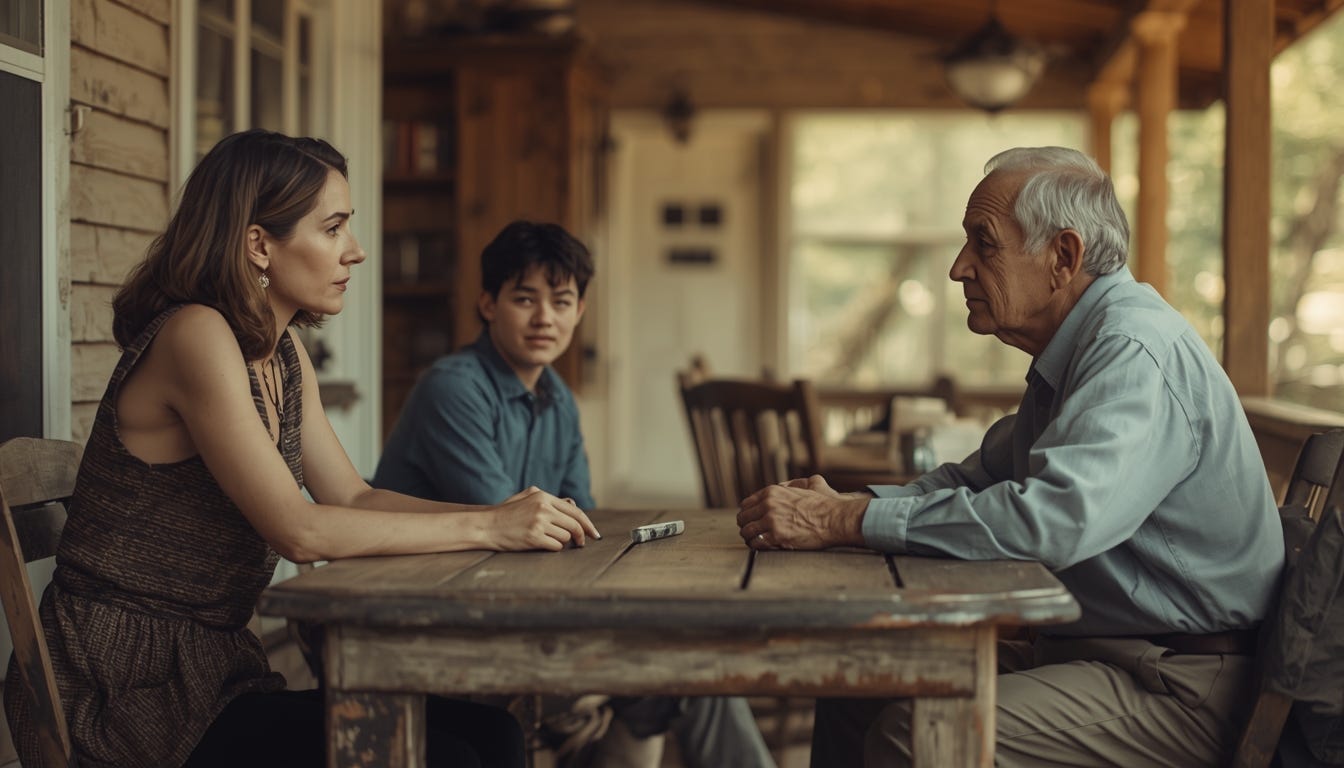
Some people find their people in the middle of things. I keep finding mine at the edges.
Outside the Middle
I’ve noticed something about myself. I connect most deeply with teenagers and the elderly. Rarely anyone in between.
It’s been there as long as I can remember.
When I was little, my grandparents were some of my favorite people.
One grandfather was talkative but soft-spoken. Quick to smile, quick to laugh. The kind of man who filled a room without demanding it.
But there was one thing he said differently. Lower. Like it was meant only for me.
Never let a man hit you.
He said it often. In the cab of his truck as he was leaving, one hand still on the door. Sitting in his recliner with me in his lap, his voice dropping to something quieter. Sometimes it came with a folded five-dollar bill, slipped to me out of sight of the other kids — a small conspiracy of love. Sometimes it came with Cajun French afterward, soft words I couldn’t translate but didn’t need to. The tenderness was the translation.
It was a promise about my own worth, delivered with the quiet certainty of someone who meant it. And I understood it more fully watching how he treated my grandmother — who was not a soft woman — with steady, unhurried respect. He said it and then showed me what it looked like from the other side.
I felt the difference before I had language for it. Between something said to manage me and something said because it was real. Because I mattered. Because he needed me to know.
I kept going back to what was real.
My grandmothers were different, and the same. What they gave me wasn’t a moment. It was a climate — continuous, across years, across every version of myself I was still figuring out. When I was finding myself. When they disapproved of my friends or my choices. When the signs of who I was becoming weren’t easy to watch.
One grandmother found out I’d been smoking cigarettes for seven or eight years, since I was fifteen, and had hidden it from her the entire time. When another family member asked what she thought about me keeping it secret for so long, she didn’t miss a beat.
“Well I guess she respected me more than she did you.”
Then she started buying me cartons of cigarettes from Mexico and mailing me one a month. Unprompted. Without a word about it.
That was acceptance. The real kind. Where someone sees exactly who you are, decides you're still theirs, and acts accordingly.
Until I couldn’t anymore, I called them regularly. They were my best friends. The kind where conversation doesn’t need to be dressed up or worked at. It just is.
As I grew, that pull widened beyond my own family.
It became the elderly in general. The sweet ones. The grouchy ones. The ones who didn’t bother smoothing themselves out for anyone. I liked that they were — fully, without apology.
I sought those connections out wherever I could.
At eighteen, in college, I started caring for elderly people in their homes.
I loved it immediately.
One of my favorite memories is of a woman who was ninety-seven years old. She wanted to chat, the way they often did, starting with simple questions that opened into something else.
She asked if I had a boyfriend. I told her I did.
Then she asked, “Only one?”
Before I could answer she stopped me. “No, no, baby,” she said. “You need to have lots and lots of boyfriends. That way you can choose the best one. That’s what I did with my Ralphie, and I tell you… I got the best one.”
It was 1998. If you do the math, she was far ahead of her time.
I still smile when I think about it. Because it was unexpected and entirely honest. It was her life, distilled into a single piece of advice, offered without hesitation or concern for how it might be received.
She was speaking from wisdom.
Something shifted as I became a parent. Everyone warned me about the teenage years. I looked forward to them because I started to recognize something familiar.
Teenagers are raw in a way most people eventually learn to hide. There's very little filtering, very little performance that holds for long. They are in the middle of becoming, and you can feel it. In the way they question, push, and say things before they know how to shape them into something more acceptable.
Most people try to manage that. I find myself wanting to meet it.
My oldest had a ritual for honesty. When she had something to confess or needed a sounding board, she would always begin by asking, "Are you busy?" In a tone that immediately told me I no longer was.
Recently, she brought it up in conversation, reflecting on what honesty in our home actually looked like. She said, with the particular directness that has always been hers, “I think I was a little too honest at times. Like when I told you I wanted to go to school to beat up the girl who wanted to fight my sister, and you wouldn’t let me. I wanted to go so bad.”
She said it like a confession and a compliment at the same time, an adult looking back at a teenager who trusted her mother enough to say the true thing, even knowing the answer would be no.
Some of the deepest connection I’ve experienced, both with my own children and the ones who pass through my life because of them, has happened in those unpolished conversations. In the honesty that hasn’t learned yet how to disguise itself.
Somewhere along the way, I recognized the pattern.
I’ve always been drawn to people at the edges.
To those who are still forming themselves, and to those who have already lived enough to stop pretending.
There’s a kind of honesty that lives there. Before identity is fully constructed. After it no longer needs to be protected.
The middle tends to be different. It’s where people are building, maintaining, managing. Where there are roles to uphold, images to protect, things at stake that make full honesty more complicated.
I understand it. I just don’t always feel at home in it.
So I keep finding myself in the same places.
Listening to the ones who are just beginning to figure out who they are, and to the ones who have already lived through enough to know what mattered and what didn’t.
Always drawn to the conversations that don't feel rehearsed, where someone says what they actually mean even if it comes out imperfectly.
That’s where I find people.
Just before the performance begins. Or just after it's no longer needed.
~Drea
Is there an age or a season of life where you've felt most seen?
How to Support My Work
Newly Published: THE EDGES OF ME: Emotional States Regulation Guide
Coming Soon: THE EDGES OF ME: Inner States Atlas
Or, if you’d like, you can support my work through Stripe with donations using the link above.
Thank you from the bottom of my heart for any support you have given or may give.
You are greatly appreciated.
I love this!!! "...before the performance begins or after it’s no longer needed.” UGH I’ve felt that my whole life but never quite had the words for.
Some people who are manage perception while others are simply being. Kids and the elderly often skip the social choreography entirely, and conversations with them can feel strangely relieving because of it.
“Never let a man hit you” repeatedly over years...some people teach your worth without ever needing to turn it into a lecture.